

|
|
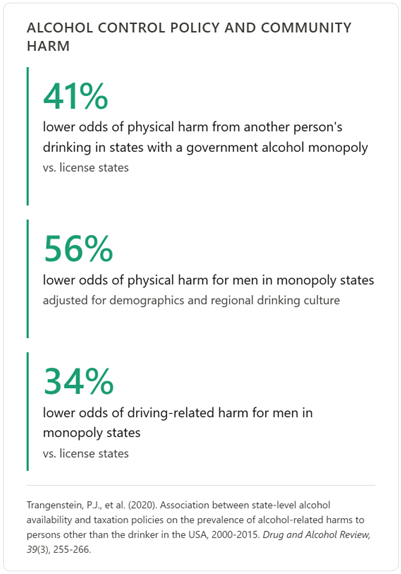
It’s clear that alcohol control policies effectively reduce alcohol consumption, but new data suggest they may also protect people around the drinker, too.
In one of the first studies of its kind, ARG research linked our National Alcohol Survey data with state and ZIP code alcohol policy data — including those from NABCA's own survey book — to examine how availability and taxation policies are associated with harm from someone else's drinking. The findings:
-
Odds of being physically harmed by a drinker were lower for those living in a state with a government alcohol monopoly.
-
People had higher odds of drink-driving related harms from others’ drinking if they lived in a community with more bars per square mile. -
Among men, higher beer taxes were associated with lower odds of physical harm by someone who had been drinking.
These data suggest monopoly systems, other thoughtful availability policies, and pricing policies could reduce harm beyond the individual drinker; they may protect families and communities.
This is the kind of policy-relevant evidence that ARG has been producing for more than 65 years. We'd welcome the opportunity to discuss how our research can support your work.
Reach out to Scientific Director Dr. William Kerr at wkerr@arg.org or visit arg.org.
Zemore et al. (mutual-help group effectiveness)
ARG's Peer ALternatives for Addiction (PAL) Study — the largest study of mutual-help group attendees to date — followed over 1,100 U.S. residents with alcohol use disorder across 12 months. Key findings:
-
SMART Recovery, LifeRing, Women for Sobriety, and 12-step groups (such as Alcoholic Anonymous) showed comparable effectiveness for supporting recovery.
-
Greater mutual-help group involvement was a strong, consistent predictor of better outcomes across all groups. Involvement was measured as weekly meeting attendance and participation in key social roles and activities (e.g., having a sponsor or close friend in the group, doing service or volunteer work).
-
ully involved participants had 2.6 times the odds of alcohol abstinence compared to those reporting no recent involvement.
-
Neither group choice alone, nor its interaction with involvement, predicted outcomes. Involvement was what mattered.
For alcohol service systems, courts, and policymakers: these findings support broadening referral options beyond 12-step groups and emphasizing active engagement over attendance alone.
Learn more about ARG's treatment and recovery research at arg.org or contact Dr. Sarah Zemore or Dr. William Kerr at wkerr@arg.org.
Martinez-Matyszczyk et al. (awareness of health risks)
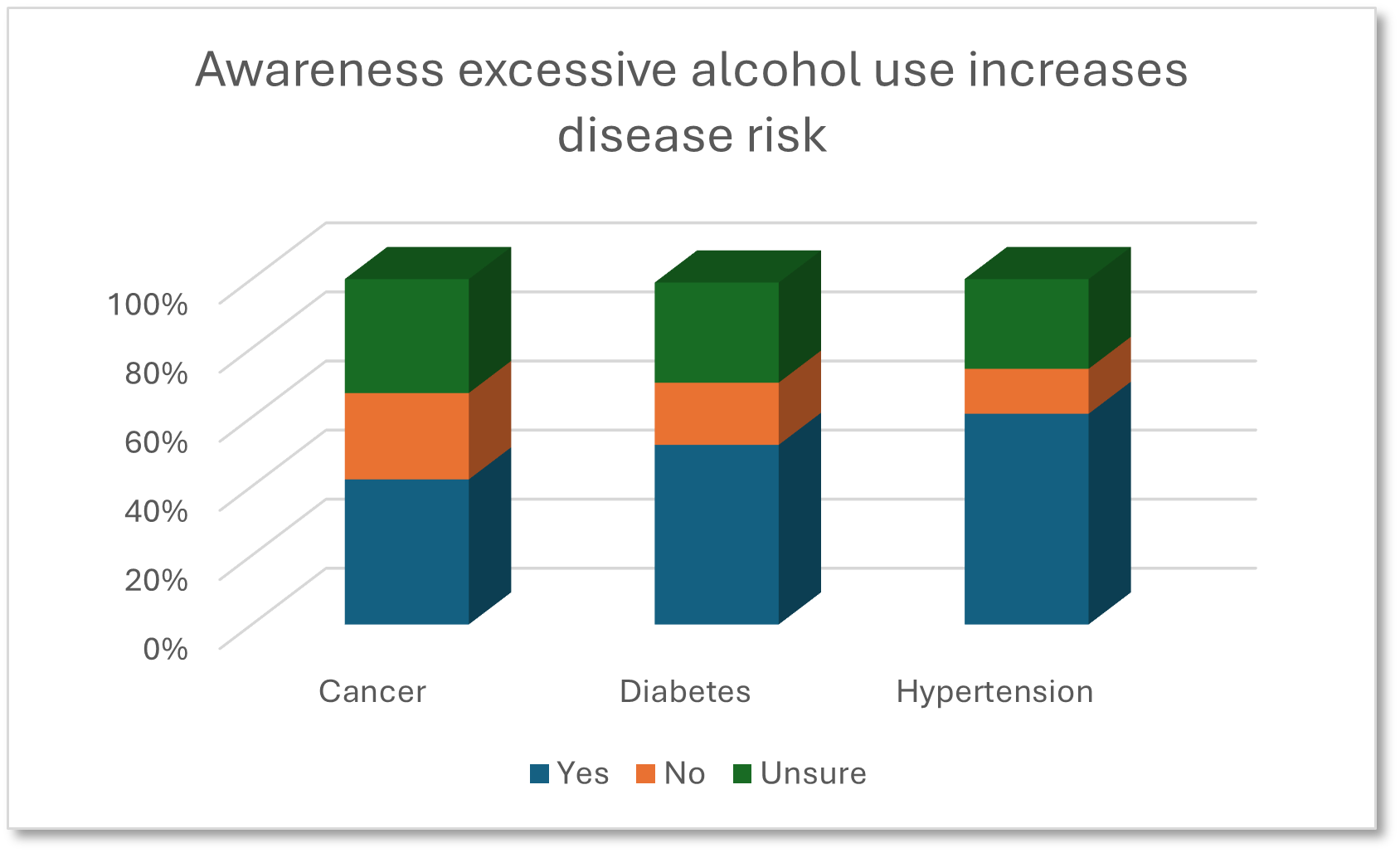
The chart illustrates that even for hypertension — the most commonly known chronic condition linked to alcohol — nearly 4 in 10 Americans either deny the connection or aren't sure.
 |
Most Americans don't know that alcohol causes cancer. And people with a history of drinking are even less likely to know.
Recent ARG research using our National Alcohol Survey data found striking gaps in public awareness of alcohol's chronic disease risks:
- Only 42% of U.S. adults recognize that excessive alcohol use increases cancer risk.
- 52% acknowledge the link to diabetes; 61% to hypertension.
- Across all three conditions, roughly 26–33% of adults aren't sure, showing a meaningful opportunity for health communication.
Critically, people's lifetime drinking history was associated with awareness of disease risk but in unexpected ways depending on the disease. Those with heavier lifetime drinking histories were less likely to know about alcohol's role in cancer, but more likely to know about its role in hypertension. This suggests that generic messaging won't work and that effective public health communication needs to be disease-specific.
For alcohol control jurisdictions thinking about public health messaging, understanding what people know (and don't know) about alcohol's health effects is foundational. ARG research can help.
Learn more at arg.org or contact Dr. Priscilla Martinez-Matyszczyk or Dr. William Kerr at wkerr@arg.org.
Kerr et al. (40-year beverage trends)
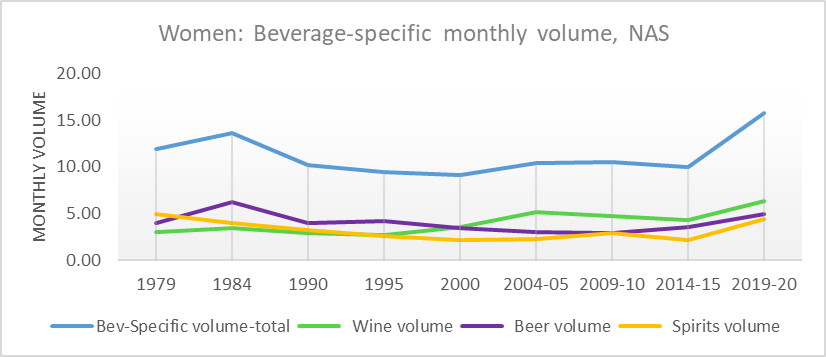
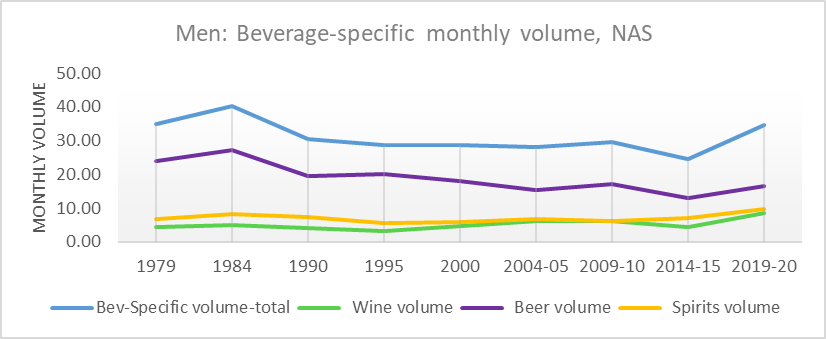
The figure shows American women's drinking climbing from 2000 to 2020, and steeply rising after 2015, with wine and spirits driving most of the increase. Men's panel shows declining beer volume offset by rising wine and spirits.
 |
 |
Forty years of US data reveal who is drinking more and experiencing alcohol-related problems, with trends that have clear implications for alcohol policy.
ARG's National Alcohol Survey (NAS) is the longest-running U.S. general population alcohol survey, tracking drinking behavior and alcohol problems since 1979. A new analysis covering 1979–2020 found:
- Women's alcohol volume in 2020 reached its highest level in four decades — 35% above 1979 levels and 15% above the previous peak in 1984.
- Wine and spirits consumption hit all-time highs for both women and men in 2020.
- Adults 65 and older showed the steepest increases in recent years, with older women's total consumption nearly tripling since 1979.
- Consumption also rose substantially among Black men and women and Latina women from 2000 to 2020.
Trends in alcohol use are not uniform across the American population, and alcohol policy needs to reflect that. Research by ARG and others points to the particular importance of pricing and availability policies in reaching groups whose drinking has been increasing fastest.
ARG's NAS is uniquely positioned to track these long-term, subgroup-level trends. Learn more about our work at arg.org or reach out to Scientific Director Dr. William Kerr at wkerr@arg.org.

Research That Speaks to NABCA's Mission
ARG's work spans the full range of questions facing alcohol control jurisdictions, from surveillance and policy evaluation to treatment effectiveness, health communications, and community-level harm.
Population surveillance and trend monitoring. Through the NAS and related studies, ARG tracks alcohol use patterns over time and by beverage type across population groups, including by sex, age, race and ethnicity, and by geographic context. We also design and field surveys for specific research questions, including rapid-response studies examining policy-relevant changes such as privatization, shifts in retail availability and cannabis legalization.
Alcohol policy research and impact analysis. ARG evaluates the public health effects of privatization, alcohol availability policies, licensing regulations, outlet density, taxation, and retail hours at the state, county, and ZIP code level. We have conducted cost-effectiveness analyses of specific policy changes and produced evidence used by state agencies, legislatures, and international bodies including the World Health Organization and the Pan American Health Organization.
Treatment, recovery, and services research. ARG studies what supports recovery from alcohol use disorder, including the effectiveness of mutual-help groups, recovery housing, and treatment services, and who is utilizing these. We examine access to care across the spectrum of alcohol services from prevention to treatment, barriers across population groups, and how policy environments shape the availability and utilization of alcohol services and recovery supports.
Research on population subgroup differences and disparities. ARG examines how alcohol use, alcohol-related harms, awareness of alcohol's health effects, and access to services vary across population subgroups. This includes population-specific research designs, comparative research that investigates social, structural and environmental factors that shape outcomes across different communities, and community-based and participatory approaches. This work spans multiple research areas and projects across ARG and informs policies and programs designed to reach the populations who need them most.
Health communications and dissemination. ARG develops and tests health messages, designs campaigns grounded in stakeholder perspectives, and produces accessible research communications, including policy briefs, fact sheets, white papers, and data visualizations, for practitioners, policymakers, and public audiences.
Technical assistance and capacity building. ARG provides evidence-based guidance to organizations implementing alcohol-related public health initiatives, supports organizations in building their own data collection and analysis capacity, and offers training on alcohol epidemiology, survey design, and program evaluation.
Connect with ARG
We are proud to be a member of NABCA and welcome the opportunity to collaborate with control jurisdictions and member organizations. Whether you are looking to understand what the data show in your state, explore partnership on a research question, or connect your staff with our scientists, we'd like to hear from you.
Please visit our website at www.arg.org or contact Dr. William C. Kerr, Senior Scientist & Scientific Director at wkerr@arg.org